The U.S. and China have extended their trade truce through January 10, 2027. The one-year suspension of the BIS 50% Affiliates Rule was part of the original Busan agreement, making the new truce date relevant to when the rule may return.
If BIS formally extends the stay, export compliance teams will have more time to prepare. With January less than three months away, companies would still have a short window to understand which counterparties may be connected to listed parties, whether their screening can reveal those connections, and how potential matches will be handled.
During the suspension, we’ve spoken with export compliance teams already assessing ownership exposure and putting BIS 50% screening in place. Their reasons for acting now go beyond the rule’s return date.
Key Takeaways
- The truce extension gives teams two dates to keep in view: The trade truce extends through January 10, 2027, but the published BIS stay still ends November 9; its provisions return November 10 unless BIS acts.
- A Shorter runway than it appears: The announcement may provide additional preparation time, but it does not make the work of understanding ownership screening any smaller.
- An opportunity to prepare: Conversations with aviation, manufacturing, life sciences and software companies show that process gaps, partner expectations and implementation decisions are prompting teams to continue preparing even during the BIS 50 suspension.
- Strengthen the broader export compliance procedures: Ownership intelligence can expose potential affiliates, but teams also need licensing systems and order processes to manage the resulting work and possible delays.
- You should know more about who you’re doing business with: Ownership transparency is a long-term expectation now. An experienced export compliance partner can help teams test their BIS 50 readiness and put the right processes in place.
What’s Been Announced—and What Remains on the Regulatory Calendar
The truce extension leaves compliance teams with two dates for BIS 50 rule planning. The broader trade agreement now runs through January 10, 2027, but the date published in the Federal Register has not changed, the BIS affiliates rule suspension is still scheduled to end November 9, 2026, with the rule’s provisions returning the next day.
Until BIS formally updates the stay, compliance teams may still want to keep November 10 in mind as a planning milestone. For ease of reference, below is a timeline of the evolution of the BIS Affiliates Rule and the preparation approach that fit each stage.
Table 1: Timeline of Key BIS 50% Affiliates Rule Updates
| Date | Development | What it Means for BIS Compliance Planning |
|---|---|---|
| September 29, 2025 | The BIS Affiliates Rule takes effect. | Ownership becomes central to determining whether certain unlisted affiliates are subject to restrictions. |
| November 10, 2025 | The one-year BIS suspension begins. | The rule’s changes to the Export Administration Regulations are stayed through November 9, 2026. |
| September 23, 2026 | The broader U.S.–China truce is announced as extended through January 10, 2027. | Anticipate a related BIS decision and monitor for it but keep procedures aligned with the published Nov 10 date. |
| November 10, 2026 | The BIS provisions are scheduled to return under the published rule. | This remains the regulatory planning date unless BIS changes it in the Federal Register. |
| January 10, 2027 | The announced end date of the broader U.S.–China trade truce. | A possible later planning horizon for BIS 50, if BIS formally extends its stay. |
The trade announcement and the BIS rule should appear together in an internal plan, with their different status made clear. That allows teams to prepare for the published date and adjust if BIS issues an extension. We will update this article if BIS publishes a corresponding change.
The Ownership Questions that a Longer Pause Will Not Answer for You
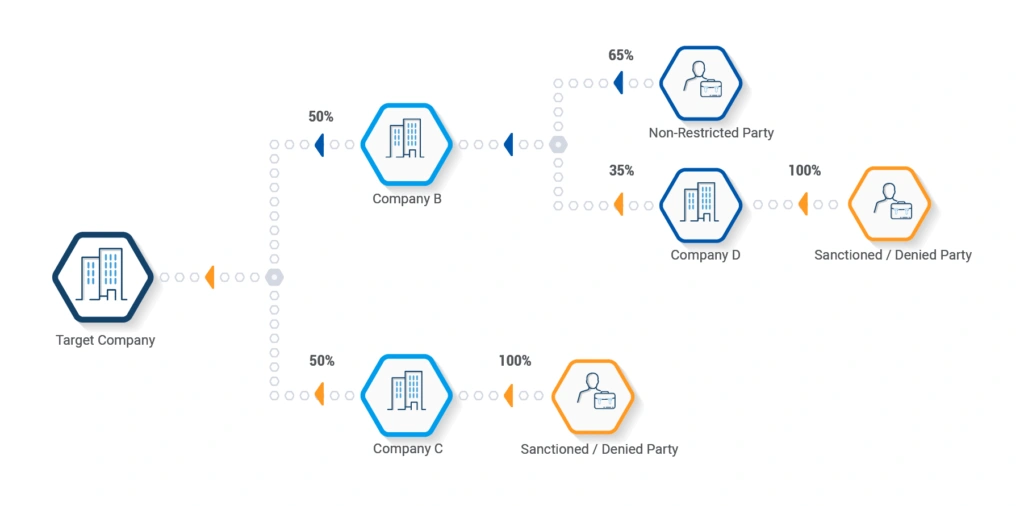
The BIS rule addresses entities that may be absent from the BIS Entity List and other restricted party list but are at least 50% owned, directly or indirectly, individually or in aggregate, by certain designated parties.
The 50% threshold sounds like a single calculation. In practice, an exporter may need to assess ownership across many existing and new counterparties, follow interests through parent companies and intermediate entities, and combine stakes held by multiple covered listed parties.
Exporters have described the breadth of the problem as deciding whether they could deal with a company meant understanding the company structure, the parties connected to it and who owned how much. The earlier BIS 50% explainer covers the ownership mechanics in more detail.
Compliance teams investigating an entity in a transaction subject to BIS regulation start with specific practical questions:
- Who owns the entities in our transactions? Screening a counterparty’s name does not establish who owns it. The relevant connection may sit several corporate layers away or arise from the combined interests of more than one listed party.
- Where is our information incomplete? Ownership records can be difficult to obtain or reconcile, particularly across jurisdictions and private companies. Teams need to know which gaps require further research and who will handle them before a transaction reaches shipment approval.
- Can we explain how we reached a decision? An ownership finding has to reach the people reviewing the transaction. They need a record of the source information, the investigation, any escalation and the decision that followed.
Those questions are difficult to answer for an entire customer or supplier base at once. They are easier to work through while there is time to identify data gaps, agree on review criteria and test the process against actual counterparties.
Image 1: Restricted-Party Ownership Structure – Required Visibility Depth Under BIS 50% rule
Why Export Compliance Teams Across Industries Are Preparing During the Pause
When the BIS 50 percent rule was initially announced, it prompted urgent questions about compliance. Those same questions have continued through the suspension. In our conversations with customers, they have come from organizations in aviation, semiconductor and specialty materials, industrial and construction products, life sciences and healthcare, higher education and research, and software and digital forensics.
Teams in these varied businesses are already adding restricted party ownership screening into their operations before BIS has settled the rule’s return date. Their reasons show why the pause has not put planning and implementation of BIS 50% controls on hold:
A Missing Process Takes Time to Build
A compliance leader in the technology-sector recently told us their organization wanted to move quickly because there was no process for this type of screening. Another company had begun planning months earlier, in August, so it could make a smoother transition when activating BIS 50 screening.
The work between “we should prepare” and a functioning review process, requires more than BIS 50% ownership data or a target date. Teams need adequate time to map out controls and compliance duties the rule mandates:
- A deeper due diligence workflow for investigating and validating ownership structures.
- Defined documentation and recordkeeping requirements that align with the affiliate rule.
- Escalation procedures for unclear or higher-risk cases.
- Criteria for reviewing ownership and control risks below 50%.
- Export licensing determination alignment with the most restrictive applicable requirements.
BIS 50 Prompted the Need for Advanced Restricted Party Screening Software
A semiconductor materials company said BIS 50 had moved advanced screening capabilities up its priority list. Likewise, a construction products manufacturer found that its existing high-risk screening system did not account for the hidden ownership question. Both organizations began evaluating software options that provided ownership intelligence for both BIS 50 and OFAC 50 percent rule sooner than planned.
The pause provides time for teams considering a similar upgrade, to examine what their current restricted parties screening tool can reveal about affiliate ownership, evaluate stronger options, and implement the capabilities they choose.
Customers or Partners Ask for A BIS 50% Compliance Plan
An aviation-sector company told us that its largest manufacturing partner was pressing it to provide a BIS 50 rule compliance program. The company needed to explain its approach to an important business partner while the regulatory situation was still changing.
Similar requests with a commercial dynamic can move through a supply chain on a customer’s or partner’s timetable. A company that has examined its ownership visibility and set out its BIS 50 screening process can give a more useful answer than one that is waiting for the next announcement.
A Clearer View of Exposure Helps Manage Cost and Effort
Export compliance teams from life sciences and software companies wanted an initial look at ownership exposure to understand the investment and implementation effort, and to build a clearer case for putting BIS 50 screening in place during the pause. Reviewing a representative sample of customers, suppliers and partners can give teams a basis for budgeting, prioritizing the first relationships to review, and assigning reviewers. By the time the rule returns, the screening and review process is already in use.

Five BIS 50 Compliance Actions to Take Before January 2027
The work below can start with a manageable group of counterparties under the current November timetable and expand if BIS extends the stay the pause to January.
1. Evaluate Existing Restricted Party Screening Coverage
Determine whether your platform detects direct and indirect ownership, including combined interests held by multiple parties covered by the BIS 50 rule. Plan a focused assessment by:
- Reviewing counterparties already in the business. Choose a relevant sample of customers, distributors or suppliers whose ownership is complex, unclear or particularly important to your business.
- Testing for ownership data gaps. Check whether your current screening provides the information and the evidence needed for ownership tracing and analysis.
2. Put Ownership Intelligence into Compliance Screening in Real Time
A name-only check cannot show every connection to a listed party. The rule requires uncovering direct, indirect, and aggregated ownership —at the same pace sanctions and export controls evolve. Deploy denied party screening tools that automatically aggregate beneficial ownership, use enriched data to monitor affiliate risks, apply real-time global watchlist updates, and enforce the “most restrictive” rule for parties tied to Entity List, MEU, or SDN parties. Putting this ownership intelligence to use during the pause gives teams time to work through results and establish review criteria.
3. Prepare to Manage More Export License Activity
Make sure an ownership finding can move into an export licensing determination. The team needs to identify the applicable restrictions, assess the items in the transaction and, where required, prepare an application. It also needs to track the application and any resulting authorization.
If those activities depend on scattered records or manual follow-up, this is a time to put a more reliable system in place. License determination, acquisition and management tools can help teams handle the additional work and keep decisions visible across the license lifecycle.
4. Connect Ownership Checks to Commercial Planning
Find out when a potential affiliate connection first becomes visible: during onboarding, at order entry or just before shipment. Research and a possible export license application can affect the time needed to fulfill an order. Sales, operations, and compliance need a way to identify those cases early and set delivery expectations accordingly.
5. Test the People and Processes for BIS 50% Readiness
Take sample transactions through the actual compliance review path, from screening through investigation, licensing review and the decision on the transaction. The exercise should show whether reviewers have the information, authority and capacity to handle the cases. Assign responsibilities, train the teams involved, and address bottlenecks while the rule is suspended.
6. Partner with an Export Compliance Technology Provider
An experienced partner can help trade compliance teams make informed implementation decisions while preparing their BIS 50 compliance program. Before selecting a vendor, ask what ownership ties its data can establish, where information remains inconclusive, how a result will appear to compliance analysts, and how results connect to export license management.
Descartes can help you bring BIS 50% Affiliates data into your operations, address questions as your team puts it into use, and provide support that can help organizations move ahead with greater confidence.

Uncover Hidden Risk in your Supply Chain with Descartes BIS 50% Solution
The trade truce extension leaves export compliance teams weighing whether to wait for a BIS update or prepare for the November return date still published in the Federal Register. Descartes is already helping teams bring BIS 50% Affiliates data into restricted party screening to surface potential ownership ties to listed parties.
Our wider suite of trade compliance solutions provides automated export licensing support, compliance screening for separate ownership requirements including OFAC 50 Percent Rule, and enhanced third-party risk management.
Ready to know more about who you are doing business with? Request a demo to see how Descartes Visual Complianceä can help you gain full visibility into ownership chains.
Find out what our customers are saying about Descartes Denied Party Screening on G2 – an online third-party business software review platform. Additionally, you can read this essential buyer’s guide to denied party screening to help you select a solution that fits your needs.