As defense manufacturers ramp up production under the International Traffic in Arms Regulations (ITAR), they are forced to confront a difficult question: when the volume of controlled exports grows, can the ITAR licensing and compliance process still support the business without becoming a source of risk or delay? That question surfaced in discussions with defense electronics, shipbuilding, aerospace, and semiconductor teams, and it’s becoming fairly common across a defense supply chain being asked to produce more.
The 2026 National Defense Strategy calls for greater production, new suppliers, advanced technologies, and allied capacity. NATO is working with industry to expand defense production on both sides of the Atlantic. New defense technology companies are entering international programs, expanding suppliers are taking on more controlled work, and established aerospace manufacturers are adding programs, personnel, and production sites. At the same time, the State Department’s Directorate of Defense Trade Controls’ (DDTC) 2026 DECCS changes place fresh emphasis on the quality of information submitted in export license applications.
More activity increases the number of compliance decisions that must be made and managed throughout the ITAR license lifecycle. New products need ITAR classification and license determination; new customers and partners need screening; DDTC applications need information gathered and reviewed across the business. Once an authorization is approved, the team must still manage its conditions, usage, and expiration, including access to technical data that may constitute a deemed export. These demands accumulate while production and international collaboration continue to move, often without a corresponding increase in compliance resources.
Descartes Visual Compliance and Descartes OCR Global EASE™ address that capacity challenge by connecting the decisions before an application with DECCS submission and the controls needed to use an approval across growing programs.
Key Takeaways
- Rising defense production creates more ITAR decisions and authorizations, often without more compliance capacity putting operations at risk.
- A reliable ITAR licensing process should follow a transaction from its first risk review through the final authorized activity because each stage of the lifecycle depends on decisions made earlier.
- Parallel DDTC applications can leave teams waiting for an answer if compliance specialists cannot see which case needs action.
- Acquisition of an ITAR license multiplies operational obligations, where shipments and technical-data access must stay within the license’s limits and conditions.
- The right software connects licensing decisions with applications and approved use, so growing teams can manage more activity without losing control.
What does an ITAR license authorize?
An ITAR license is DDTC’s approval for a specified export or temporary import of defense articles, including technical data where applicable. Its terms define the activity the business may carry out: which articles are involved, who may receive them, where they may go, and any limits or conditions DDTC imposes.
An ITAR license approved for one customer delivery should not be assumed to cover a new partner, additional items, a different destination, or the release of controlled technical data to a non-U.S. citizen. As a producer makes changes, the export compliance team must determine whether each activity fits an existing authorization or needs a new application or amendment.
Table 1: DDTC’s DECCS Licensing Guide for Principal ITAR License Forms and their Corresponding Amendments
| ITAR License | Activity it Covers | Amendment to an Approved License |
|---|---|---|
| DSP-5 | Permanent export of unclassified defense articles and related technical data | DSP-6 |
| DSP-61 | Temporary import of unclassified defense articles | DSP-62 |
| DSP-73 | Temporary export of unclassified defense articles | DSP-74 |
| DSP-85 | Export or temporary import of classified defense articles and related classified technical data | No paired amendment form listed in DDTC’s licensing guide |
ITAR authorization also extends beyond these DDTC license forms. A technical assistance agreement (TAA) may be needed to provide defense services to a foreign party, while a manufacturing license agreement (MLA) addresses authorized production abroad. Both require DDTC approval and have terms that govern what the parties may do. Releases of controlled technical data to foreign persons in the United States—which may constitute a deemed export—also require an authorization assessment. In some circumstances, an ITAR exemption may apply instead of a license, provided its conditions and recordkeeping requirements are met. A DSP-83 may also be required with certain licenses or agreements involving significant military equipment or classified defense articles. It is a nontransfer and use certificate, not a separate license type.
Maintaining visibility into exactly what each authorization permits becomes increasingly important for both compliance and operational planning when ITAR-controlled activity scales up.
How to Get an ITAR License and Manage It with Export Compliance Software
The ITAR licensing process is often a shared dependency across multiple defense programs. Logistics may be preparing a customer export while engineering needs an ITAR classification for a new product, sales introduces another foreign partner, and operations plans work under an existing approval. Each request raises practical questions: Does an existing authorization apply? Is additional approval required? Can the activity proceed now, or is agency review still pending?
Teams facing a growing set of decisions in operational environments like this find export license management software useful when it helps connect the information, decisions, and controls that span all phases of the ITAR licensing lifecycle.
Image 1: Three Phases of ITAR Licensing
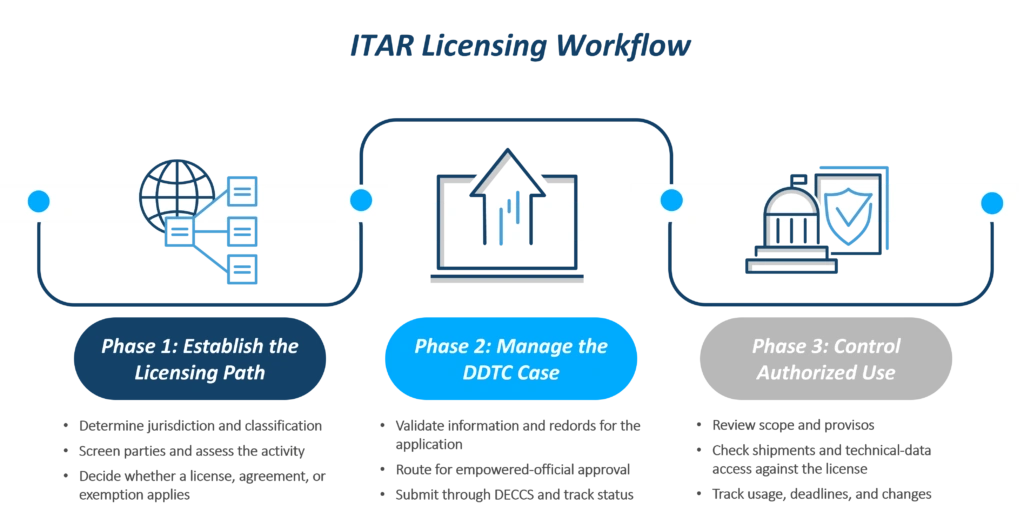
Phase 1 — Before Applying: Connect Risk Screening, ITAR Classification and Export Licensing Determination
The first step in the ITAR licensing process is determining jurisdiction to establish whether an item, software, or technical data is subject to the ITAR or another export control regime such as the EAR. If it is ITAR-controlled, ITAR classification must identify the applicable U.S. Munitions List (USML) category. The assessment then turns to the proposed transaction to review who is buying the article, who will receive it, where it will go, and how it will be used. Those answers shape the ITAR license determination and may show that a license exemption or DDTC-approved agreement is the appropriate path.
Restricted party screening belongs in that assessment and should not be left until the shipment stage. A screening match involving a customer, end user, or other party can change how the transaction is classified for risk, which authorization path is appropriate, or whether the transaction can proceed at all. Finding that issue after the team has committed to an application can mean redoing the work already underway.
The quality of the information used to review jurisdiction, classify products, screen parties, and determine authorization requirements directly affects everything that follows. When it is unreliable or disconnected, every later stage of the licensing process inherits those errors.
An aerospace manufacturer showed how easily the underlying decisions can become disconnected. Its team relied on a large export classification spreadsheet that contained gaps and inaccurate codes, yet it remained the primary source of information used to support export decisions. With new international opportunities approaching, the team recognized that those gaps would not stay confined to the spreadsheet because an incorrect USML entry could affect the authorization sought, the information submitted to DDTC, and later the team’s understanding of what an approval covers. Its ITAR licensing challenge existed before anyone opened a DDTC application.
This scenario illustrates what an end-to-end export license management solution is designed to address. Descartes’ denied party screening software connects directly to the ITAR licensing workflow, so decisions can be made using current compliance information. The USML classification and export license determination tools help teams document the product and transaction decisions on which ITAR licensing activities depend. Improving decision quality at the pre-application stage reduces rework throughout the ITAR licensing lifecycle and gives teams greater confidence in the information used to support DDTC application filings.
Phase 2 — During Application: Prepare, Submit, and Track ITAR License Requests
In an ideal ITAR compliance program, the application phase does not begin with a blank DDTC form. The work already done in the review phase becomes the basis for a DDTC request. Related export licenses may provide useful product and program history to help populate the new request form. Carrying that information into the application gives reviewers a sound starting point and helps them catch inconsistent descriptions or missing details before submission.
While export licensing decisions may create several DDTC requests in parallel, applications typically move at different speeds through internal and agency review. One may be waiting for engineering input, another for the empowered official’s signature, and a third for DDTC’s decision. A defense electronics team planning repeated overseas equipment demonstrations wanted to see how its DSP-73 applications moved through internal review and DECCS submission, as well as who would own the resulting authorizations. Clear case status and ownership help when production plans depend on an answer and the same compliance team is managing several open cases. If no one can see who owns the next action, an application may be sitting within the company, while the another team assumes it is already under DDTC review.
In the same vein, while tracking agency status, the team needs a controlled workflow to respond to requests for information (RFIs) and decide how to proceed when an application is returned without action (RWA). Each case should have an owner, supporting documents, and a record of what response is being prepared. Otherwise, an unanswered request or avoidable application error can disrupt the transaction that depends on it.
Our export license acquisition workflow powered by Descartes OCR Global EASE reduces errors, supports continuity, and speeds up the application phase with configurable application templates, data validation checks, and forms that can be populated with information from existing authorizations. The team can review the details for the new request, route it for internal approval, verify required information, and submit directly to DECCS. From there, tracking the application alongside its supporting documents, RFIs, RWAs, amendments, and assigned actions helps stakeholders manage the case through DDTC’s decision. The value is visible when a team can carry its reviewed transaction facts into the filing and keep the application history available for the people who will use the authorization.
Recordkeeping is another key benefit of ITAR licensing automation. DECCS provides submission and agency status, but it does not by itself capture the manufacturer’s full internal review process or the decision chain that supports a filing. Export compliance software retains the application, supporting information, correspondence, internal reviews, and final decision as part of its export licensing record.
Phase 3 — After Approval: Translate License Conditions into Operating Controls
When an ITAR license is approved, its conditions must be translated into operational decisions. The export compliance team has to review the approval, address any provisos, and make its limits clear to the people who will use it. Once an authorization enters operational use, requests often arrive from multiple directions at once which can be hard to manage amongst other ITAR compliance activities.
The defense electronics team’s overseas demonstration scenario shows how much there is to track after a DSP-73 license is approved. The team needs to know which equipment has gone abroad, what has returned, what remains available under the authorization, and when it expires. Authorization ownership, supporting records, and review communications are all part of understanding what the approval still permits. Repeat demonstrations make that a continuing task rather than a single release decision. If logistics records those movements in one system while compliance updates license usage elsewhere, the two can fall out of step.
Descartes export license manager solution integrates with business systems to support usage tracking and decrementation. Combined with Export Documentation Manager, export operations can check ITAR license requirements, prepare shipment documents, and handle EEI/AES filing as part of the movement the authorization supports.
The same questions arise whenever programs evolve. An approval may contain provisos, usage limitations, reporting obligations, expiration dates, or other conditions that affect when and how the ITAR license can be used. Those conditions should be considered when program scope changes or new activities are proposed, because the existing authorization may need to be reassessed before work proceeds. The team may also need to meet reporting and close-out obligations after the shipment itself. With dozens or hundreds of active ITAR licenses and agreements, relying on institutional knowledge, an “approved” status, or disconnected records makes it harder to determine whether planned activity remains authorized. Losing track of dates, changes, and quantities can lead to activity outside an approval’s terms or hold up work that could proceed.
This is where export license management software supports day-to-day operations, bringing ITAR licenses and agreements, provisos, authorization ownership, supporting documents, usage records, deadlines, alerts, and audit history into a centralized workflow. ITAR license management automation makes approved authorizations understandable, traceable, and usable throughout their operational life even when transactions, authorizations, and stakeholders grow.
Best Practices When ITAR Licenses Span Programs, People, And Borders
The following practices help prevent a valid authorization from being used in a manner that violates ITAR conditions.
- Treat a changed program, person, or destination as a new decision point
- Apply the same discipline to deemed exports and technical data
- Keep multi-jurisdiction authorizations connected but distinct
- Maintain an audit trail beyond DECCS
- Create policies, training, audits, and recordkeeping procedures to use and manage authorizations consistently
Questions to ask when choosing ITAR license management software
A growing defense team can use a current program to test whether a platform supports the work it will actually perform:
- Risk determination: Can the team connect ITAR classification, restricted party screening, and license determination, then carry those decisions into an application?
- Application preparation: Can engineering, program management, logistics, and compliance contribute and review the information needed for a DDTC request without losing the history of changes and decisions?
- DDTC workflow: Can the team validate an application, route it to an empowered official, submit it through DECCS, and track agency status, RFIs, and RWAs while retaining its own application record?
- Use after approval: Can compliance and export operations check parties, scope, provisos, dates, and available quantities or value before an activity proceeds? Can usage be updated from actual shipment data?
- Technical data and deemed exports: Can an authorization be connected to specific people, programs, data, and access periods, including activity with no physical shipment?
- Change management: Can the team identify whether a proposed change requires an amendment, a new application, or another authorization?
- Allied programs: Can U.S. and other jurisdictions’ authorizations be linked to the same program while preserving each approval’s separate scope, conditions, and history?
See How Your ITAR Licensing Workflow Can Improve with Descartes
The test of an ITAR licensing process is whether it holds together across a growing portfolio of programs, people, and authorizations. In a personalized demo, we can show you how Descartes Visual Compliance and Descartes OCR Global EASE connect ITAR classification, restricted party screening, and export license determination with DDTC applications, proviso management, authorized use, technical-data access, utilization tracking, and close-out.
Request a demo to see how that workflow could support your ITAR programs.