Changes to the Defense Export Control and Compliance System (DECCS) bring practical questions for export compliance teams: What changed? What does my licensing team need to do differently? Are our systems and processes ready to support the new requirements?
Those questions became particularly important with the Directorate of Defense Trade Controls’ (DDTC) Data Collection Modernization (DCM) changes, which went into production on September 14, 2026. The update affects multiple Department of State (DOS) licensing forms, data requirements, validations, and submission processes, including expanded disclosures that require teams to collect and verify more information earlier in the application process, placing greater pressure on the quality of data flowing into export licensing.
Trade compliance teams often depend on information created and maintained elsewhere in the business, and when that data is incomplete, inconsistent, or unfamiliar under the new requirements, the impact can move quickly from a validation issue to a delayed export license approval. A product ready to ship can miss its freight schedule, remain at the port, or arrive too late to meet a customer commitment.
Understanding that potential operational friction, our team prepared the Descartes OCR Global EASE™ platform for the regulatory changes more than three weeks ahead of the DDTC cutover, giving customers additional time to implement the update, adjust to the added criteria, and reduce the risk of disruption around the transition.
To look at what the DECCS updates mean in practice, I spoke with Descartes’ Saurabh Arora, Director of Product Management, and Robert Lewis, Lead Product Manager, who worked closely on the engineering effort, about how the transition impacts trade compliance, where teams may encounter challenges, how evolving DDTC requirements affected the project, and the work involved in keeping an integrated export licensing process ready for regulatory change.
Key Takeaways
- DECCS changes expanded / adjusted data captured, modified validations, and disclosure updated field formatting requirements across multiple Department of State licensing forms.
- Descartes absorbed changing DDTC requirements, rework, testing, and rollout preparation so customers did not have to manage that burden themselves.
- DECCS readiness depends on accurate data, adaptable workflows, and technology that can support regulatory change without disrupting ITAR licensing operations.
- Without integrated licensing technology, teams may face repetitive manual submission, disconnected records, weaker auditability, and greater data-governance burden.
- Effective export licensing technology should support submission, lifecycle management, audit trails, enterprise data integration, and ongoing regulatory adaptability.
What Should Compliance Teams Know About the DECCS Changes?
The DCM initiative affects several commonly used Department of State licensing forms, including DSP-5, DSP-6, DSP-61, DSP-62, DSP-73, and DSP-74, as well as Agreements and Agreement Amendments.
The changes include revised data fields, validation requirements, form structures, and additional data elements involving areas such as end-user classification, party roles, end-use systems or platforms, and Major Defense Equipment.
Export licensing teams will need to become familiar with more than a redesigned DECCS interface, because the new and expanded fields change the information that must be available and verified as an application is prepared.
Robert Lewis explains the risk:
Users unfamiliar with the updated requirements could enter information that does not satisfy the criteria for newly mandated fields, potentially contributing to a Return Without Action (RWA) and lost time while an application is corrected and resubmitted.”
Application administrators also need to understand the configuration changes associated with the transition so the updated version can be implemented and activated appropriately.
DCM readiness requires access to the updated DECCS forms alongside the data, processes, and technology needed to complete them accurately. Descartes OCR Global EASE uses built-in validations to help users identify data issues prior to submission and provides additional guidance around the information required.
What Happens Behind the Scenes When DECCS Changes?
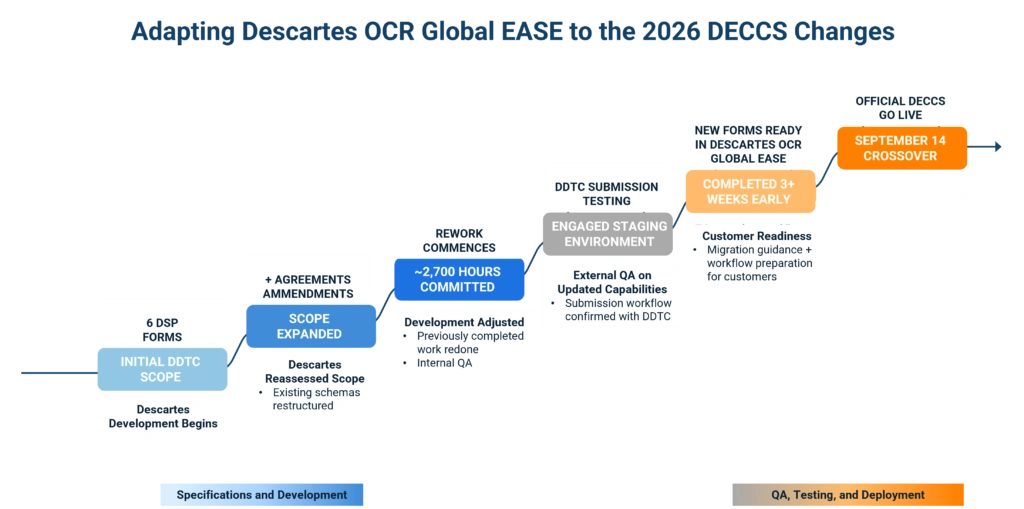
The work to prepare Descartes OCR Global EASE began well before the September 14 cutover. Descartes had already begun development against DDTC’s initial specifications when Agreements and Agreement Amendments were added to the original six DSP forms in scope. DDTC also restructured schemas affecting forms already under development, requiring the team to revisit completed work.
“Our team was able to absorb the increased scope and a decent amount of rework of what had been completed based on the initial requirements,” Lewis explains.
Much of that additional work would never be visible from looking at the updated forms. DECCS forms rely on common and form-specific schemas that determine where information is referenced and how it is validated. Subsequent changes moved some of those references. Even where the underlying data had not changed significantly, the way different elements connected to that data had.
The experience illustrates why regulatory implementation has to accommodate change while work is already underway. When specifications are clarified or expanded, teams need to quickly reassess the impact on licensing data and workflows, adjust the technology, and retest before users rely on it.
Being able to absorb change is especially important when licensing activity and the exports dependent on it still need to continue throughout the transition.
Image 1. DECCS Update — From Initial Scope to Cutover
What Helps Export Licensing Technology Keep Pace with DECCS Changes?
Direct involvement in the submission process gave Descartes an important view into how the updated requirements would work in actual licensing workflows. During the project, the team used DDTC’s staging environment to test the new specifications against live scenarios.
That direct involvement is particularly relevant because DescartesOCR Global EASE is one of only a very small number of platforms with direct batch submission capability to DECCS. Descartes also brings long-standing experience with Department of State electronic licensing environments, including earlier systems such as SNAP and the evolution toward today’s Defense Trade Licensing System within DECCS.
Firsthand experience with government licensing programs helped the team assess how DECCS changes affect data capture, validation, submission workflows, and the platform itself. The process requires regulatory and product teams to understand the change and its impact, engineering to translate it into the platform, and testing to confirm that submissions work as intended. When DDTC requirements evolve again, that same process begins again.
As Saurabh Arora emphasizes:
We may not control when regulatory requirements change or how those requirements evolve. What we can control is the process used to understand them, assess their downstream implications, translate them into the platform, test the response, communicate with customers, and adapt when further changes arrive.”
How Can Trade Compliance Software Make Regulatory Transitions Easier to Manage?
Preparing the software early was only part of the transition; customers also needed flexibility to implement the changes around active DOS licensing operations.
As Lewis defines it, the goal was to separate the software upgrade from the regulatory cutover. Configurable form-version management within Descartes OCR Global EASE made it possible for customers to install the updated version while continuing to create applications under the existing form configuration. At the September 14 cutover, administrators could activate the revised form version for newly created records, allowing customers to upgrade early without switching early.
Descartes also provided structured migration paths, data-mapping guides, and workflow validation sessions to help compliance managers, system administrators, and operational users prepare for the change.
With this approach, customers had more control over the transition while preserving continuity for in-flight ITAR license applications. It also provides greater flexibility for managing future form-version changes as DDTC requirements evolve.
What Work Would Compliance Teams Have to Manage Without an Integrated Export License Solution?
The work involved in the DCM production release would have required organizations without an integrated export licensing solution to dedicate significant internal resources to interpreting and implementing DDTC changes—effectively turning the transition into a substantial internal technology project.
Maintaining the Systems Behind DECCS Submission
A self-managed batch submission process shifts regulatory change directly onto internal product, IT, and compliance resources.
Lewis describes the burden in practical terms:
A company using batch submission without Descartes OCR Global EASE would have needed to implement the same underlying changes required by the updated DDTC specifications.”
For this update, the Descartes team logged approximately 2,700 hours across requirements analysis, development, QA and testing, training, and deployment preparation.
With Descartes OCR Global EASE, that regulatory and technical work is managed as part of maintaining the platform.
Managing the Work Around Export License Submissions on DECCS
For most organizations without direct integration, the burden of adhering to the new DDTC criteria means transferring information from internal systems into DECCS manually, even when other trade management technology is already in place.
Companies frequently raise this issue when evaluating export licensing technology. Re-entering application data is one source of friction, but the work surrounding submission is broader: verifying information, screening parties, managing internal review, maintaining supporting documents, monitoring status, and preserving the records and audit trail associated with the application.
Lewis highlights that Descartes OCR Global EASE applies additional data quality controls before submission, including checks between related application data and integrated denied party screening.
Maintaining an Audit Trail Beyond DECCS
DECCS cannot serve as an organization’s system of record, so companies submitting directly still need a reliable way to maintain that history. When records are spread across various tools and systems, reconstructing the full licensing trail can become difficult during audits or internal reviews.
Descartes OCR Global EASE maintains the application and associated export licensing activity within the same environment, providing traceability from preparation and review through submission and ongoing license management. That gives compliance teams a more complete record of the actions and information supporting their licensing decisions.
Why Do the New DECCS Requirements Put More Pressure on Enterprise and Licensing Data?
The expanded DECCS disclosures depend on data that often originates well outside the licensing function. Export compliance teams may be responsible for the application, but they rarely create or own every piece of the data feeding it.
ERP, CRM, and other business systems are typically structured around commercial transactions, accounting, customer management, and inventory—not changing ITAR licensing requirements. A customer name or ship-to address may exist in an enterprise system, for example, without the regulatory classification, party-role detail, or other context needed for a DECCS application.
That enterprise system-to-DECCS gap becomes more visible when new disclosures require additional information earlier in the licensing process. Compliance teams may need to collect, verify, or add regulatory context to data coming from sales, engineering, operations, and other organizational tools before it can support an application.
Moving that information manually between systems creates more opportunities for incomplete, inconsistent, or incorrectly mapped data. If those issues aren’t identified ahead of submission, the consequences of poor data can be immediate. For a shipment waiting on authorization, that can mean missed freight schedules, storage or demurrage costs, field personnel waiting for equipment, or a customer delivery date put at risk.
The responsibility behind the data matters for Empowered Officials (EOs), who may rely on information supplied by several departments when reviewing and certifying license applications. Under ITAR § 120.67, EOs are expected to verify the legality of the transaction and the accuracy of information submitted, while understanding the civil, criminal, and administrative penalties associated with ITAR violations. As disclosure requirements expand, weak data controls can increase both organizational compliance risk and the regulatory exposure of the individual certifying the application.
A few practices can help strengthen export licensing data governance:
- Establish Cross-Functional Data Ownership: Map required DDTC data to its source and assign clear ownership across functions such as sales, engineering, contracts, and program management. Compliance should verify data, not generate it.
- Bridge the Enterprise Data Gap: Connect enterprise data with the licensing workflow so regulatory context, cross-field validation, and data-quality controls can be applied before information reaches DECCS.
- Strengthen Controls Before EO Certification: Use system-enforced validation and sign-off controls to identify missing, unverified, or conflicting information before submission, giving Empowered Officials greater confidence in the data they certify.
- Maintain End-to-End Traceability: Preserve the source, supporting information, and history behind licensing data through submission and the resulting license record.
Connecting enterprise data with licensing workflows and applying validation before submission can help close the gap between commercial systems and regulatory requirements. Early validation can therefore support data governance and supply chain continuity alongside export compliance.
What Does Effective Export License Management Require Beyond DECCS Submission?
The DECCS changes put greater emphasis on the data, controls, and technology surrounding a license application. Those same considerations continue after an application is submitted and approved. Arora frames the broader requirement this way:
There are two key parts to it. License submission is one piece of the process, but many organizations are equally focused on managing, tracking, and maintaining traceability throughout the lifecycle of a license.”
Companies looking to automate their export licensing process regularly have direct DDTC submission high on the list because they want to eliminate duplicate entry and move away from manually transferring information between internal systems and government portals.
But their questions quickly expand to: How will users track where an application stands? Where will supporting documentation be stored? How will Empowered Official access be controlled? What happens after approval? How are conditions and provisos managed? Can license quantity be decremented? Will users know when a license is approaching expiration or exhaustion?
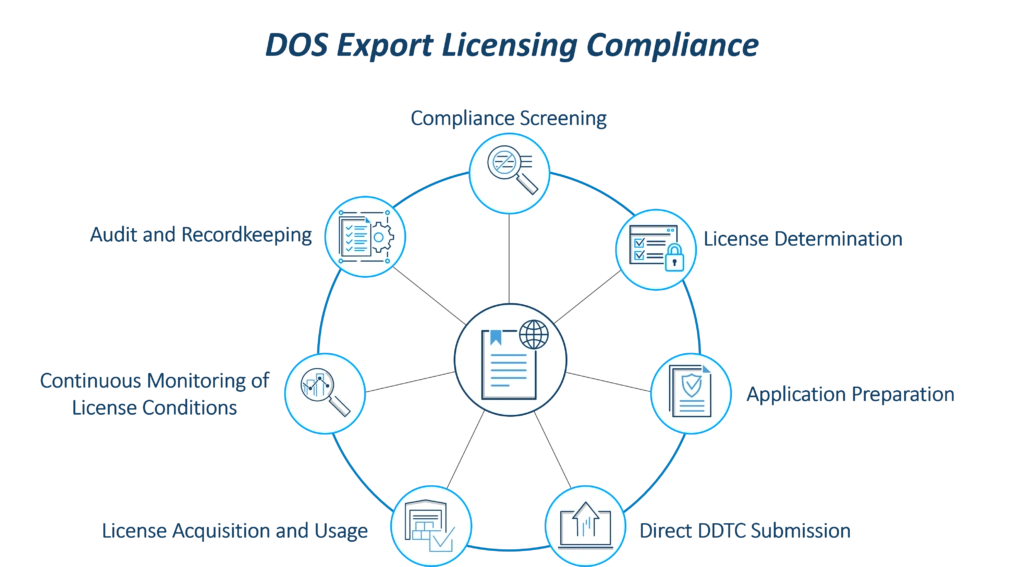
Image 2. DECCS Export License Compliance Loop
Key Export Licensing Software Capabilities that Help Support Full Lifecycle Management
- Export Classification
- Export License Determination
- Export License Acquisition – application preparation and data capture, internal review and approval workflows, direct DDTC submission and status tracking, supporting document management
- Integrated Denied Party Screening
- Real-time screening embedded into licensing and order workflows
- Export License Usage and Authorization Management – License conditions and proviso tracking, value and quantity decrementation, license expiration and exhaustion monitoring, license renewal
- Audit trail and recordkeeping
- Integration with ERP and other enterprise systems
- Role-based access for licensing users and Empowered Officials
Descartes OCR Global EASE brings those capabilities into a centralized licensing environment, helping organizations manage application preparation, submission, and approval, usage, tracking, and auditability.
Build a More Adaptable Department of State Licensing Process with Descartes
Descartes OCR Global EASE helps organizations stay aligned as government licensing requirements evolve, without shifting the full burden of regulatory monitoring, system updates, testing, and workflow changes onto internal teams.
Built-in validations, streamlined data capture, and connected licensing workflows can help reduce submission errors, improve efficiency, and support faster adoption of new requirements.
For organizations evaluating their current process, the value extends beyond today’s DECCS update. Descartes combines export licensing technology with the regulatory, product, and engineering expertise needed to keep that technology current as requirements change.
Talk to an expert to see how Descartes trade compliance solutions can help simplify Department of State licensing with integrated application preparation, restricted party screening, direct DECCS submission, tracking, auditability, and export license management. Request a demo today.