Over the past year, I’ve spoken with organizations across manufacturing, technology, healthcare, aviation, logistics, publishing, non-profit, and other industries that decided to replace their denied party screening vendor.
The reasons vary, but the same issues come up repeatedly: too many alerts, too much manual work, poor support, integration problems, new trade compliance risks, and sanctions screening processes that become harder to control as the business grows. Price sometimes contributes to the decision but, more often, it is one part of a larger question:
Is our current screening process still sustainable?
That question tends to surface well before a company formally starts looking for another provider.
Watch: What Makes Companies Switch Denied Party Screening Vendors
In this video, I discuss the operational, regulatory, and growth-related pressures we see when organizations begin reassessing their denied and restricted party screening solutions. The article goes deeper into what triggers denied party screening software replacements.
Key Takeaways
- Among the companies I’ve helped, switching usually starts when their screening solution no longer fits what the compliance program needs today.
- Poor-quality screening results and inefficient review processes can overwhelm teams, slow investigations, and make everyday compliance work harder to manage.
- Changing risk requirements, global expansion, acquisitions, and rising transaction volumes can expose limitations in coverage, consistency, scalability, and cost.
- Audits, enforcement actions, and internal compliance reviews can raise the standard for defensibility and reveal weaknesses in existing screening controls.
- When replacing a solution, companies should prioritize result quality, workflow control, defensibility, scalability, support, and evidence from real users.
Sanctions Screening Results Create More Work than Teams Can Manage
One of the clearest reasons organizations replace their screening solutions is alert volume.
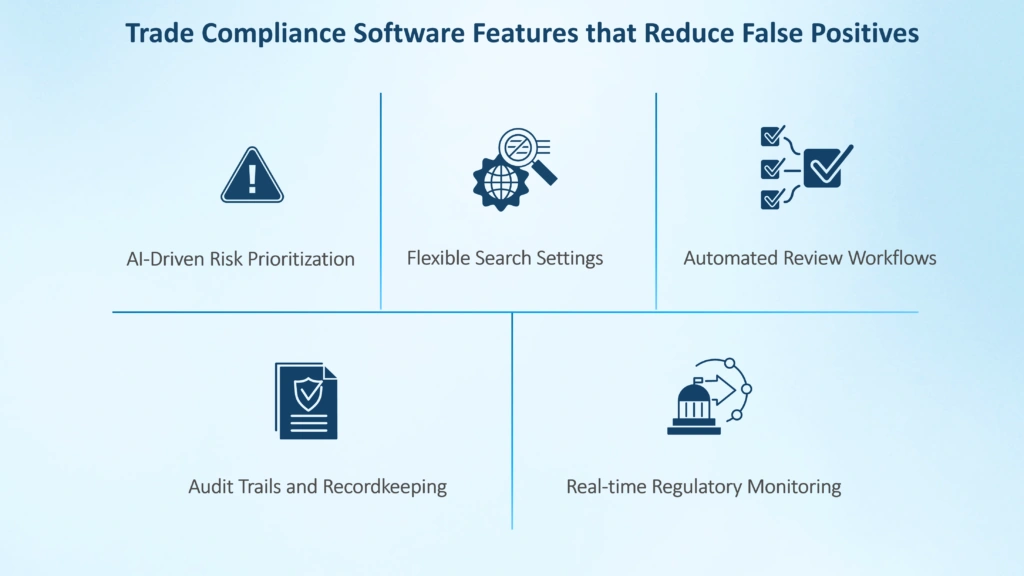
I recently spoke with an organization whose compliance team was reviewing thousands of false positive alerts every week. Their sanctions screening software generated too many low-quality matches, without capabilities such as advanced matching algorithms, flexible search tuning, and risk-based prioritization to help reduce and prioritize the results requiring review. Analysts were spending much of their time clearing alerts rather than investigating higher-risk activity.
At that point, teams understandably start asking, why is so much of our time going into managing the screening tool? When a large dataset produces too many low-quality matches, even a small compliance team can quickly face a growing review backlog. Better result quality helps focus limited analyst time on the matches that actually warrant closer attention.
Image 1. Capabilities Required to Support Alert Quality
Screening Reviews and Investigations Take Weeks or Months to Complete
One university we spoke with had screening and review cycles that could take two to three months because results were being managed across multiple documents and systems.
Every step involved in getting from a screening result to a documented decision was happening across disconnected systems. It became harder to know what had been reviewed, whether the right stakeholders were involved, what still needed attention, who was responsible for the next decision, and where records and supporting documentation were maintained.
We hear similar frustrations from companies where screening is poorly integrated with business systems such as Salesforce. Compliance and business teams may have to move between applications, duplicate information, or manage review activity outside the customer record. That adds friction to everyday screening and makes it harder to maintain a clear history.
These organizations often come to us looking for capabilities that bring the process together:
- Collaborative workflows for reviewing and resolving alerts
- Automated documentation of screening and adjudication activity
- Centralized reporting across reviews, teams, and decisions
- System-generated audit trails that capture the review history
Underneath many conversations, compliance leaders are asking whether they can easily see where a review stands, who has acted on it, and why the final decision was made.
New Trade Compliance Risks Expose Gaps the Original Tool Was Never Built to Handle
Traditional denied and restricted party screening remains fundamental, but many compliance programs are now being asked to understand a wider range of risk. Organizations may need greater visibility into ownership relationships, supply chain concerns such as forced labor, or regulatory developments that require more context than a simple name match can provide.
I’ve seen this with companies that initially chose a basic, lower-cost solution that met the needs of a simpler compliance environment. As the risk landscape changed, they needed more intelligence and flexibility than their existing trade compliance system could provide.
The denied party screening solution that was the “right fit at the time” was no longer the right fit today.
Growth Has Created Inconsistent Compliance Screening Processes
Global growth creates another kind of pressure. One manufacturer came to us for help standardizing compliance screening across more than 200 business units worldwide. Screening had evolved differently across the organization, with some business units using different vendors and others applying due diligence checks inconsistently.
That fragmentation often develops as companies expand into new markets or acquire other businesses, bringing additional systems, screening tools, and compliance requirements. Companies then need a platform with the global reach to support multiple jurisdictions while enforcing consistent screening practices such as centralized policies for batch screening, automated re-screening, mobile access, and escalation rules across business units.
A broader trade compliance platform can also help reduce vendor sprawl. Instead of adding another point solution every time a new requirement emerges, organizations can bring screening and related compliance processes onto one platform and maintain greater visibility across the business.
This is something I see more often as companies grow through expansion and acquisition. They are looking for fewer disconnected systems, more consistent controls, and a platform that can support the way they want trade compliance to operate globally.
Transaction Volume Changes the Operational and Economic Equation
Screening volume can change the outcome of a “good enough” solution. One ecommerce platform I worked with needed to screen more than 60 million transactions every year. At that scale, system performance and automation become critical because even small inefficiencies can have significant consequences when they are repeated millions of times.
Scale can also reveal challenges in pricing models. I’ve seen organizations realize that a solution that looked cost-effective initially becomes much more expensive as transaction volumes, customer or supplier databases, and screening requirements expand. That can accelerate a vendor review, especially when higher costs come with more alerts, analyst effort, weak support, or functionality gaps.
Long-term value comes down to whether the solution can support growth without driving disproportionate increases in software costs or compliance workload.
Regulatory Scrutiny Can Turn Compliance Gaps into Urgent Priorities
An enforcement action, audit, voluntary disclosure, or internal compliance review can quickly change the standards an organization expects from its screening program.
Recent enforcement actions show why. In 2026, OFAC reached a $275 million settlement involving apparent Iran sanctions violations after transactions continued despite red flags. BIS also imposed a roughly $252 million penalty in another case and required the company to complete two internal audits of its export compliance program.
I see the same pressure in companies reviewing their own compliance programs before an enforcement event occurs. In one sales conversation, an industrial plastics manufacturer was particularly concerned about whether it could rely on its system to keep up with OFAC exposure and other regulatory risks without depending on individuals to catch every development themselves.
Organizations with these concerns are pushed to look more closely at the controls behind their screening: whether the system is reliable, whether decisions and activity can be reconstructed, whether policies are being enforced as intended, and whether the organization would be comfortable defending the process under scrutiny. If the answer is uncertain, vendor reevaluation can move up the priority list quickly.
When Vendor Support Becomes Part of the Reason to Switch
Poor customer service is one of the most consistent reasons companies give us for considering a change. I hear the same frustrations repeatedly: support tickets that remain unresolved for weeks, unclear answers about functionality, and, in some cases, declining service after a provider is acquired and established support teams change or disappear. At some point in the conversation, these frustrations lead to a fair question:
“Why are we paying for a solution if we are still solving the problems ourselves?”
Slow support can have real operational consequences in compliance. If screening is connected to customer onboarding, order processing, exports, or other business workflows, an unresolved technical issue can hold up activity.
Poor customer experience also changes what teams want from the software itself. Several organizations have told us they want more control over routine compliance work rather than having to open a support ticket every time they need to make a change or resolve an issue.
They want to manage more of the process themselves, with knowledgeable support available when they actually need it.
Buyers Want Evidence of Better Screening Solutions from Real Users
When an organization is replacing an existing solution, they approach the evaluation process differently from a first-time buyer. The team already knows where the pain points are, so they are more interested in knowing: Who has actually used this successfully?
Independent reviews and peer experiences tend to carry significant weight during a replacement process. They can provide additional perspective on areas such as ease of setup, support, usability, results, and the experience of working with the provider.
We have had organizations discover Descartes through platforms such as G2 and Capterra because they wanted to understand how the software performs after implementation—directly from other users instead of relying only on what appears on a product’s feature list.
For a company that has already been disappointed once, that outside validation can reduce some of the uncertainty involved in making another change.
Descartes Denied Party Screening software has been well worth our investment. The system has caught several entities in our existing customer/vendor base that were fine one day but were flagged as bad actors the next day. It helped us shut them down, thus preventing heavy fines or loss of export privileges. Our company could not be happier with the results.”
– Verified G2 Review. Read More.
What Should You Look for When Replacing a Denied Party Screening Solution?
The exact requirements will vary by organization, but the replacement conversations I have tend to come back to a similar set of practical needs:
- Improve the Quality of Screening Results. Advanced search and matching algorithms, flexible search tuning to reduce false positives and risk-based alert prioritization are capabilities you should look for to help reduce low-value matches and focus analyst attention where it matters most.
- Make Reviews Easier to Manage and Defend. The review process should simplify investigations, support collaboration, document decisions, and maintain a clear record of what happened. Features such as collaborative review workflows, automated documentation, centralized reporting, and system-generated audit trails can help improve efficiency.
- Keep Pace with Changing Regulatory Risk. Screening should continue working as sanctions, ownership structures, and other compliance risks evolve with automated and continuous re-screening, ownership screening and broader risk intelligence, and support for emerging risks such as forced labor.
- Fit Screening into the Way the Business Operates. An effective solution should work across the systems, teams, and jurisdictions where denied party screening actually takes place. An effective solution should work across the systems, teams, and jurisdictions where denied party screening actually takes place, with integrations to major business systems such as Salesforce, support for batch screening, mobile access, and other screening methods. It should also enable consistent screening policies across global operations while providing centralized visibility across business units.
- Support Growth Without Disproportionate Cost or Complexity. The solution should be able to handle increasing volume and broader requirements without creating another scalability problem. Teams should also be able to manage routine trade compliance activity themselves while still having access to knowledgeable support when they need it
Select A Sanctions Screening Solution that Catches Risk Today and Tomorrow with Descartes
The common thread across the organizations I speak with is that their screening software did not necessarily stop working overnight. Over time, their compliance needs changed until the solution they started with no longer fit the program they were running.
Descartes trade compliance platform is designed to support that evolution. Our modular solutions allow organizations to start with online denied party screening, expand into integrated screening workflows, and extend into broader import and export compliance areas such as product classification, export licensing and operations, ownership screening, forced labor compliance, and other risk management needs.
As part of the Descartes Global Logistics Network™, customers can bring more of their global trade compliance processes onto one platform as their requirements grow.
If some of the challenges discussed earlier sound familiar, connect with me for a personalized demo of how Descartes can help reduce manual review, improve visibility, strengthen auditability, and support screening as your compliance requirements evolve.
Read what customers are saying about Descartes Denied Party Screening on G2, or grab a copy of our buyer’s guide to denied party screening to help you select a solution that fits your needs.